

What do you need at your wedding venue for bell tents?
Last updated
Short answer
For bell tents, your wedding venue needs power at every tent, ground that steel tent pegs can go into and access that a box truck can drive on, over ground protection mats if necessary. You also tell us where pipes run underground, arrange permission from the owner or the municipality (gemeente), and make sure someone is there for the set-up. Power and water are at your expense.
- Power
- At every tent
- Ground
- Steel pegs must go in
- Access
- Box truck can reach it
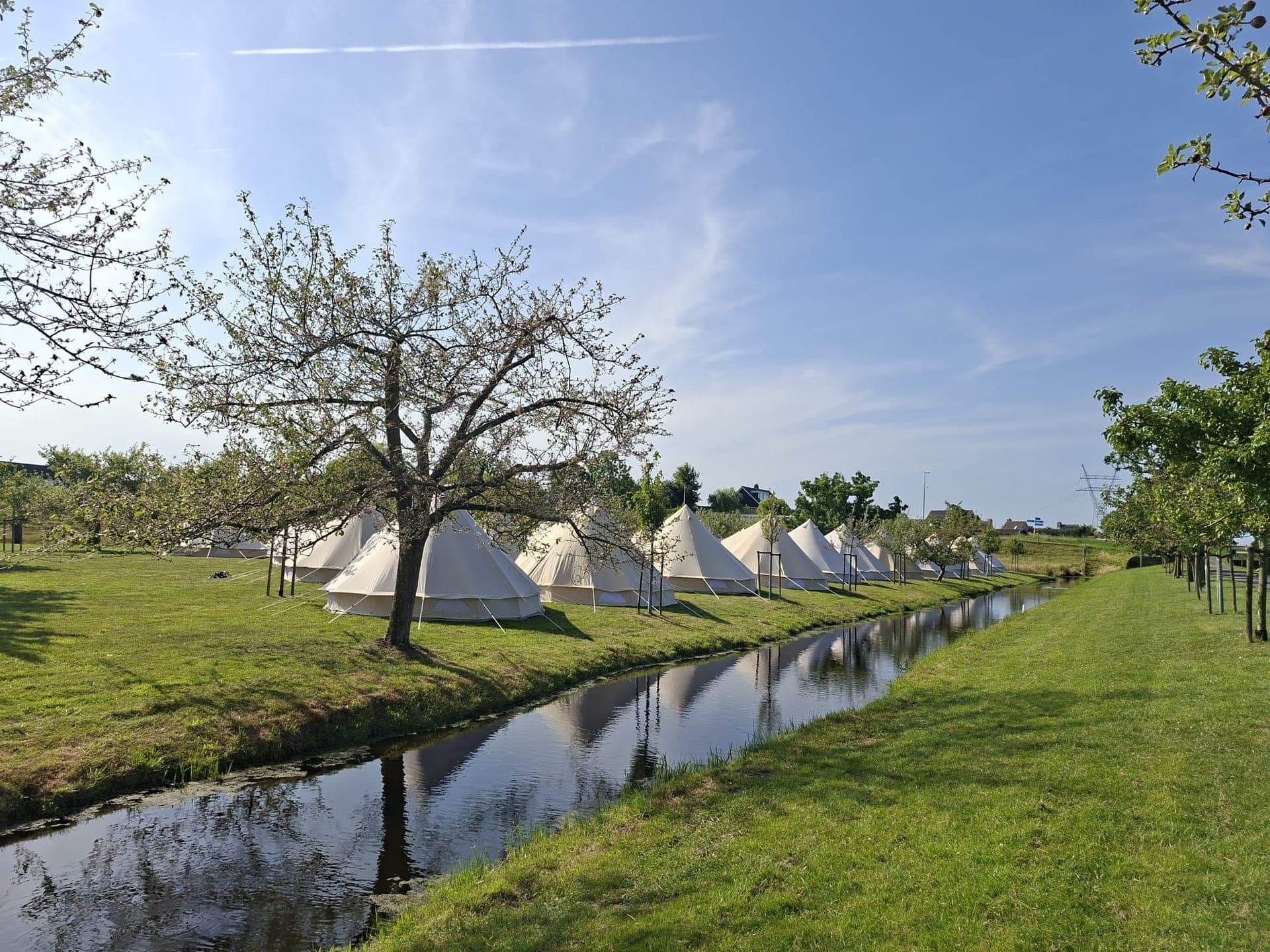
A bell tent cannot just go anywhere. It has to be anchored firmly in the ground, it needs power for the lighting, and our box truck has to be able to reach it. Below you will find each requirement with its reason, the questions to put to your wedding venue and what you arrange yourselves.
The checklist for your wedding venue
A wedding venue is ready for bell tents if it meets the requirements below. They come from our terms and conditions; go through them before you request a quote.
- Power at every tent, for the lighting. Power and water are at the hirer's expense.
- Ground that steel tent pegs can go into.
- A venue that a box truck can reach and drive on, with a trailer if needed, and ground protection mats where necessary.
- Tell us where pipes, cables or ducts run underground.
- Permission from the owner or the municipality where it is needed; the hirer arranges this.
- Someone present at the agreed time for the set-up.
If you are unsure about any point, put it in your quote request or email a few photos of the spot to hello@honeybell.nl. A question beforehand is always better than a surprise on the day itself.
Why each requirement matters
Each requirement has a practical reason: the tent has to stand securely, have light and be set up and taken down without damage. The table shows for each requirement why we ask for it and what you can do about it.
| Requirement | Why | Tip |
|---|---|---|
| Power at every tent | For the light in and by the tent | Ask the venue where the connections are |
| Pegs must go into the ground | That is what holds the tent firmly | Choose a grass field |
| Reachable by a box truck | We bring the tents and furnishings in it | Watch for gates, small bridges and soft ground |
| Tell us about pipes and cables | A peg can hit a pipe | Ask the owner what is underground |
| Permission from owner or municipality | They decide whether the tents may stand there | Arrange it before the booking is definite |
| Someone at the set-up | You point out the spot | Agree who will be there, with a phone number |
What ground is suitable for bell tents?
Grass works: the steel tent pegs go into it and the tent stands firmly. Tent pegs are the stakes that fix the tent to the ground all the way round, and every tent must be able to be anchored with steel pegs.
A hard surface needs to be discussed with us first. Pegs cannot go into paving slabs, block paving, concrete or tarmac, so always check such a spot with us beforehand. We will then look together at whether there is a place on the site where the tents can be firmly anchored. If you are unsure about sand, gravel or a meadow that quickly gets wet, send a photo too.
Also watch what is under the grass. If there are cables, pipes or ducts in the ground, for example for garden lighting, a sprinkler system or drainage, tell us: a peg can hit a pipe like that.
What access does the wedding venue need?
The spot has to be easy to reach and drivable for a box truck, with a trailer if necessary. A box truck is a truck with an enclosed cargo area; we use it to bring the tents, the beds and the furnishings to the field.
If there is soft ground between the road and the spot for the tents, ground protection mats are needed: mats you lay on the ground so that a vehicle does not sink in. You arrange those, where necessary. Honeybell is not liable for ruts in the grass or other damage to the grounds, and ground protection mats help prevent that.
During the set-up and the take-down, make sure there is enough free space around the field and on the route to it. You can read how those days go at set-up and take-down of bell tents.
How much space do bell tents need?
Each tent has a diameter of 5 metres, and you need room around it for the pegs and for walking. An example: ten tents side by side in a row are already 50 metres long with no gaps between them. In a circle, an arc or two rows, a tent village sometimes fits a field better.
Exactly how much space you allow per tent depends on the layout and the ground. We settle that as soon as we know your spot. In stormy weather we agree a safe layout with you in advance. When you choose the spot, look at these points:
- A level piece of ground, without holes.
- Power nearby, so that few cables run across the grass.
- Toilets within walking distance, because guests go there at night.
- Some distance from the dance floor and the bar, for anyone who wants to sleep earlier.
- A walking route that is easy to see in the evening.
What questions do you ask your wedding venue?
Ask your wedding venue about power, access, the spot for the tents, toilets and end times, and do so before you book. With the answers, we can take your spot into account in the quote straight away.
- Where are the power points, can every tent get power and what does the usage cost?
- Can a box truck, with a trailer if necessary, drive right up to the field, or are ground protection mats needed?
- Where may the tents go, and are there cables, pipes or ducts in the ground there?
- Are toilets and showers open at night for the guests who are staying overnight?
- How late can the party go on, and what are the rules for music?
- Is the field free the day before for the set-up, and the day after for the take-down?
- Can the venue's caterer provide breakfast the next morning?
- Is permission from the municipality needed for guests to sleep in tents?
You can read more about toilets, showers and breakfast at breakfast, toilets and showers in a tent village.
What do you arrange yourselves and what does Honeybell arrange?
We deliver the tents, set them up, furnish them and clear them away again. You take care of the spot and of what that spot needs.
| Part | Who arranges it | Note |
|---|---|---|
| Set-up, furnishing and take-down | Honeybell | At the agreed times |
| The spot for the tents | You | We may ask for a different spot |
| Power and water | You | Connection and usage are at your expense |
| Ground protection mats | You | Only where the ground calls for them |
| Permission | You | From the owner or municipality, in good time |
| Toilet and shower | In consultation with the venue | Or a trailer through our partner |
| Breakfast | The venue's caterer | We are glad to coordinate with them |
Whose permission do you need?
The owner of the land, and sometimes the municipality too; you arrange that permission as the hirer. If you are getting married at a wedding venue, first ask there whether tents with an overnight stay are allowed on the grounds. On a meadow, an estate or in a family member's garden, you ask the owner.
Whether the municipality needs to know differs from municipality to municipality; you can read about that at permit for tents at your wedding. If you are getting married at home, also look at getting married in your own garden with an overnight stay.
Do not wait until just before the wedding. If you cannot get permission, our terms and conditions put that risk on the hirer, and any fees that an owner or anyone else charges for placing the tents are for you as well.
How we do it at Honeybell
We set up the tents, furnish them and clear everything away again. You provide a spot with power at every tent, ground that pegs can go into and a road that our box truck can drive on. The prices per tent are on the homepage; we price transport, set-up and take-down per location. If you are unsure whether your spot is suitable, put it in your quote request and we will think it through with you.
Frequently asked questions
- What is power at every tent needed for?
- For the lighting. Every tent must be able to get power, for example for the 15-metre string of lights (€15 per tent): warm light along the tent poles and above the bed. Faulty electrical appliances are not allowed under our terms and conditions, even if guests bring something themselves.
- Who pays for the power and water at the venue?
- You do, as the hirer. Under our terms and conditions, the costs of the power supply, the power usage and the water supply and drainage are the hirer's. Ask your wedding venue beforehand what they charge for this, so that it does not turn up as a surprise on the venue's invoice.
- Can you put up bell tents if there is no power in the field?
- Every tent must be able to get power for the lighting; that is in our terms and conditions. If there is no connection in the field itself, work with the venue to find a way to get power to the tents, and put it to us beforehand. That way we know where we stand on the day itself.
- What happens if the ground is soft after rain?
- Ground protection mats are then needed to get the box truck to the tents; you arrange those. Under our terms and conditions, Honeybell is not liable for rutting, the tracks that wheels make in soft ground. If the spot is unsafe or unworkable, we may postpone or stop the work. So if in doubt, talk to us beforehand.
- Who pays for damage to a cable or pipe in the ground?
- The hirer does. Damage to the grounds, buildings, pipes or other objects caused by placing the tents is at the hirer's expense under our terms and conditions. That is why we ask you to tell us where cables, pipes or ducts run, so that we can put the pegs well away from them.
- Are a fire pit or fireworks allowed near the tents?
- Not in or around the tents. Fireworks and open flames, including candles and gas heaters, are not allowed there under our terms and conditions, for reasons of fire safety. If you want a fire pit at the party, put it well away from the tent field and agree that with the venue.
- Can you decide for yourselves where the tents go?
- Yes, the hirer decides the spot; that is what our terms and conditions say. If we find a spot unsuitable, unsafe or too risky for damage to the tents, we can ask you to point out another one. That is why it helps if we see a photo or a sketch of the field beforehand.
- Does the wedding venue need toilets at night?
- Your guests must be able to get to a toilet at night, and that is arranged in consultation with the venue. If the venue has no toilets open at night, we can have a toilet and shower trailer from a partner we work with brought in. Ask about it in your quote request.
- How do you know whether your venue is suitable?
- Go through the checklist on this page and ask the venue about power, access and the spot for the tents. A tent has a diameter of 5 metres and a round floor of about 20 m², so measure the space as well. If you are unsure, put it in your quote request.