

Bell tent, tipi, safari tent or lodge tent: which sleeping tent suits your wedding?
Last updated
Short answer
A bell tent is round with one centre pole, a tipi a pointed cone, and a safari or lodge tent rectangular on a frame. For one night at the wedding venue, with two guests per tent, a bell tent fits well. A safari or lodge tent suits longer stays or families wanting separate rooms, a tipi anyone who mainly wants the pointed shape. Honeybell hires out only bell tents, from €175.
- Bell tent
- Round, one centre pole
- Tipi
- Tall, pointed cone
- Safari and lodge tent
- Rectangular, on a frame
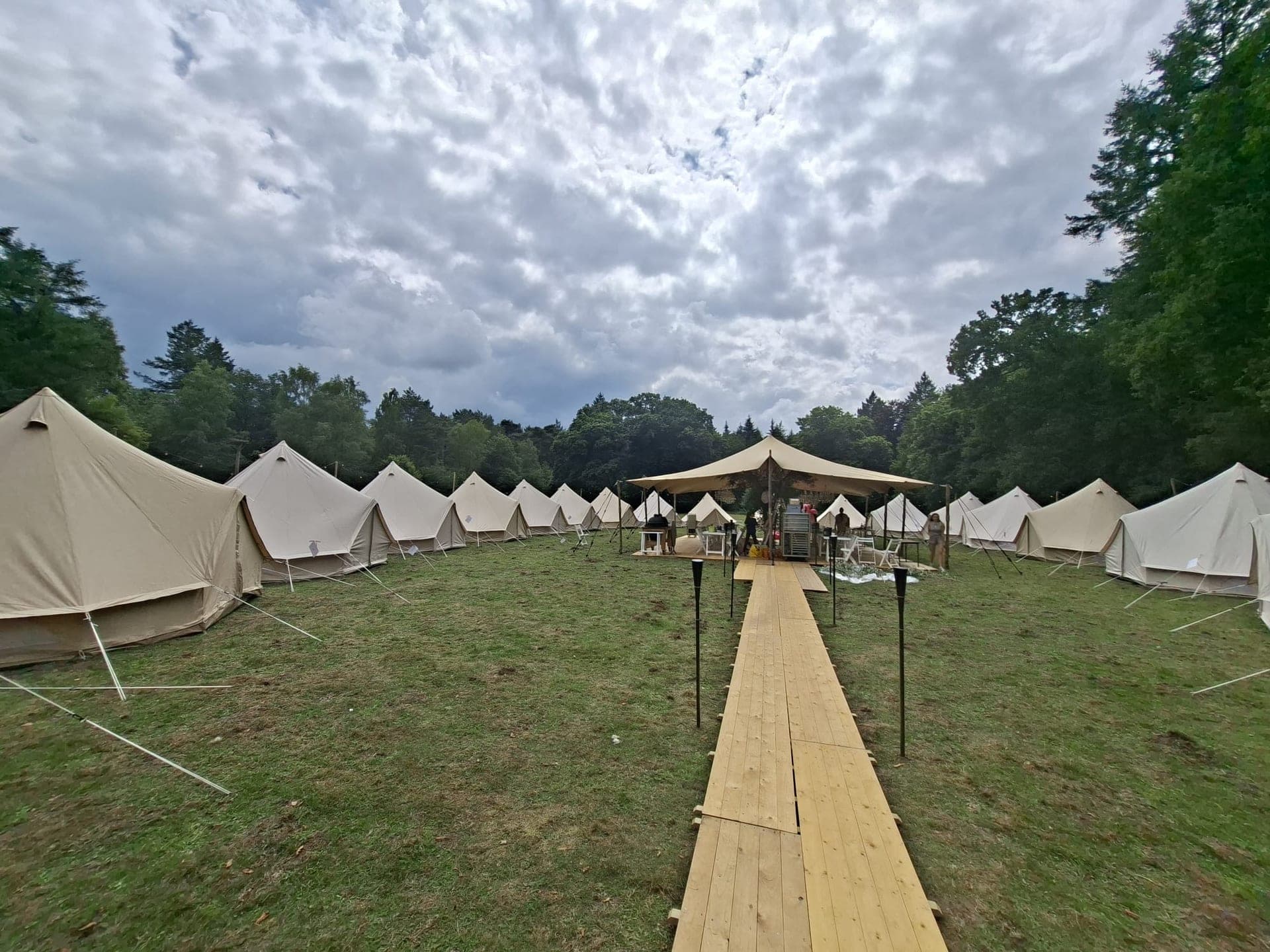
At weddings and parties with an overnight stay you come across four kinds of sleeping tent: the round bell tent, the pointed tipi, the rectangular safari tent and the lodge tent, usually a larger or more luxurious safari tent. They differ in shape, standing height, sleeping places and set-up. We only hire out bell tents ourselves, but below we set them side by side honestly, including where another tent fits better.
The four sleeping tents side by side
The biggest difference is the shape: round, pointed or rectangular. The rest follows from that, from what holds the tent up to where you can stand upright, how many beds fit in and how much work the set-up is.
| What to compare | Bell tent | Tipi | Safari or lodge tent |
|---|---|---|---|
| Shape | Round, low straight wall, sloping roof | Pointed cone, sloping to the ground | Rectangular, straight walls, pitched roof |
| Size | With us 5 metres across, over 3 metres high | Varies by tent | Varies by tent |
| Sleeping places | With us two comfortably, four at most | Fewer beds than the diameter suggests | Beds against the wall, sometimes separate sleeping areas |
| Standing upright | Around the centre pole | Only in the middle | On most of the floor |
| Set-up | One centre pole, canvas and pegs, no frame | Several poles or one centre pole, canvas and pegs | A frame of wood or metal, often with a floor: the most work |
| Space in the field | A circle, plus guy ropes all round | A circle, plus pegs all round | A rectangle, plus any veranda |
| Rain and wind | With us thick, waterproof canvas and steel pegs | Depends on the canvas and anchoring | Depends on the canvas, frame and anchoring |
| Feel | Round and cosy, one space | Tall and eye-catching in the field | Like a room, sometimes with a veranda |
| Best for | One night after the party, or as a bridal suite | A striking spot, a lounge or photos | More nights, families, holiday parks |
| At Honeybell | For hire, from €175 | We do not hire these out | We do not hire these out |
The bell tent: round, with one centre pole
A bell tent is a round canvas tent that stands on a single pole in the middle. A low, straight wall runs all the way round, and above it the canvas slopes up to the top.
Guy ropes, the ropes from the canvas to the ground, and pegs keep the tent taut all round. A frame is not needed. Inside it is one round space: high by the pole, lower towards the edge.
The tipi: a tall, pointed cone
A tipi is a tall, pointed tent in the shape of a cone, with the canvas running from the tip to the ground. The classic tipi stands on several poles that meet at the top, a shape that comes from the tents of nomadic peoples on the prairies of North America. There are also modern tipi tents on a single centre pole.
Because the canvas runs from the tip straight down to the ground, a tipi is tall in the middle and low along the whole edge. It stands out: the tip rises high above the field, and a group of tipis gives a tent village a silhouette of its own. Large tipis are also used as party or lounge tents, and on campsites and glamping sites you can stay the night in a tipi.
The safari tent and the lodge tent: rectangular, on a frame
A safari tent is a rectangular tent on a frame, with straight walls and a pitched roof, often on a wooden floor. Inside it feels most like a room: you can stand upright almost everywhere, and beds and a cupboard fit against the straight walls.
There are safari tents with separate sleeping areas or a covered veranda. You often see them on campsites and glamping sites, as a tent that stays up for longer.
A lodge tent is a relative of the safari tent: also rectangular, on a frame and with straight walls. The name has no fixed meaning. Usually it is a larger or more luxurious version, on holiday parks sometimes with a kitchen or a private bathroom, so with a lodge tent always ask exactly what is inside.
Size, sleeping places and standing height
Look not only at the size, but at how much of the floor you can use standing up and where the beds go. With camping tents, tipis and bell tents included, the stated number of people usually assumes sleeping mats side by side; with real beds far fewer people fit in.
Our 5-metre bell tent has a round floor of about 20 square metres (calculated) and is over 3 metres high in the middle. It sleeps two guests comfortably on a double bed, with room for a second bed or a cot; with four it fits too, but it gets cosy. The layout for different numbers of guests is in how many people sleep in a bell tent.
A tipi has less floor at standing height than a bell tent of the same size, because the wall slopes all the way to the ground; you cannot tell that from the diameter alone, so ask how many beds really fit. A safari or lodge tent has the most standing height thanks to its straight walls, and with separate sleeping areas parents and children each get a corner of their own.
Set-up, space in the field, rain and wind
A tent on poles goes up faster than a tent on a frame: a bell tent or tipi consists of a pole or poles, canvas and pegs, while a safari or lodge tent has a frame and often a floor. Ask any hire company how long the set-up takes, what the ground has to be able to take and when the tent will be gone again.
Allow for more space in the field than the tent itself: there are guy ropes or pegs all round, sometimes a veranda with a safari tent, and you want a path between the tents. How much space that is depends on the layout: in a row, in a circle or in small groups.
How a tent copes with rain and wind depends mainly on the canvas, the anchoring and the layout, less on the shape. A round tent or cone has no long, straight side to catch the wind; with a rectangular tent it matters which way it faces.
Our bell tents are made of thick, waterproof canvas and are held down with steel tent pegs. In a storm we discuss a safe layout beforehand, and in extreme weather we may decide not to set up or to take down early. There is more in a bell tent in rain and cold.
Which tent suits which occasion?
A bell tent suits best for one night at the wedding venue, with two guests per tent. It gives them a round room of their own, with a real bed if you choose that, and it stays in the field only briefly: from 12:00 on the wedding day until 12:00 the next day, after which we take it down. It also works well as a bridal suite, see a bell tent as a bridal suite.
For a party without a wedding it works the same way, see bell tents for a family weekend, festival or company event. Another tent suits better if guests stay longer, if a family wants separate spaces or if you mainly want the shape of a tipi:
- More nights in one place. If guests stay for a long weekend, the space of a safari or lodge tent with a floor, straight walls and sometimes a veranda counts for more: you live in it rather than just sleep in it. You can ask about a second night in our bell tents in your quote request.
- A family that wants to sleep separately. A safari or lodge tent with separate sleeping areas gives parents and children a corner each. With bell tents you solve that with two tents side by side.
- The shape. If you are looking for a tall, pointed tent that stands out from afar, for the photos or as a lounge for example, a tipi suits better.
The feel differs too: a bell tent is round and cosy, a group of tipis stands out from afar and a safari or lodge tent feels like a room. If you would like to combine bell tents with tents from another hire company, ask about it in your quote request.
What Honeybell's bell tents are like
With us you choose per tent how far the furnishing goes, from the empty tent to a styled room:
- Tent only, €175 per tent: the empty tent, delivered, set up and cleared away afterwards. Your guests bring their own bedding.
- Sleep-ready, €295 per tent: two beds with mattresses, bed linen for two and a 15-metre string of lights. The bed is made up and ready.
- Fully styled, €412.50 per tent: the same, plus a 9 cm mattress topper, a storm lantern and the styling package, with furniture, rugs, ornaments and flowers.
We charge transport, set-up and take-down per venue; they are listed separately in the quote. We deliver across the whole of the Netherlands and Flanders.
Which questions should you ask before you choose?
Start with your plan, not the tent: how many nights, how many guests per tent and how much space there is. These questions help with any hire company:
- Do the guests stay one night after the party, or a whole weekend?
- How many sleep in each tent, and do families want to be together or apart?
- How much space is there in the field, and can pegs go into the ground?
- Can a lorry get right up to the field, and is there power at every tent?
- Does the tent only have to be a place to sleep, or also a place to sit, get changed or have photos taken?
- When is the field free for set-up, and when does it have to be empty again?
For bell tents, what the field needs is in what you need at your wedding venue, and how many tents your guests need is in how many bell tents you need.
How we do it at Honeybell
We only hire out bell tents. We deliver them, set them up, furnish them and clear them away again the day after, across the whole of the Netherlands and Flanders. You see the price per tent and per furnishing straight away in the quote form; transport, set-up and take-down follow in the quote. If you are unsure whether a bell tent fits your plan, just ask us in your quote request.
Frequently asked questions
- Why is a bell tent called a bell tent?
- Because of its shape. A low, round wall with a sloping roof rising to the top looks like a bell. Our bell tents are 5 metres in diameter and over 3 metres high, and stand on a single centre pole with steel tent pegs all round.
- Is a tipi the same as a bell tent?
- They are different, even though they look alike from a distance: both are round with a point. With a tipi the canvas runs from the tip to the ground, while a bell tent has a low, straight wall all round. That makes a bell tent higher along the edge than a tipi.
- What is the difference between a safari tent and a lodge tent?
- Small, and the names overlap. Both are rectangular tents on a frame with straight walls; lodge tent is usually the name for a larger or more luxurious version. So for either one, ask exactly what is in and under it: a floor, beds, bathroom facilities.
- Can you also hire a tipi or safari tent from Honeybell?
- Not from us: we only hire out bell tents of 5 metres, from €175 per tent, across the whole of the Netherlands and Flanders. We deliver them, set them up, furnish them and clear them away again. If you are looking for a tipi, safari tent or lodge tent, you will need a different hire company.
- Which tent is best with children?
- With young children a bell tent works well: next to the double bed there is room for a second bed or a cot, and a maximum of four people fit in. If parents and older children would rather sleep apart, take two bell tents side by side. Also read children in a bell tent at a wedding.
- Which sleeping tent suits a festival wedding?
- That depends on how long the guests stay. For one night after the party, bell tents with two guests per tent are a practical choice; with Sleep-ready, at €295 per tent, the bed is ready when the party is over. You can read how to set up a wedding like that in a festival wedding with an overnight stay.
- Is a safari tent more expensive than a bell tent?
- That differs from one hire company to another, and we do not quote other companies' prices. So always compare the total: the tent, the furnishing, transport, set-up and take-down. With us a bell tent costs €175, and €295 with bed, linen and light; transport, set-up and take-down are listed separately in the quote.
- What is a glamping tent?
- A glamping tent is not a separate type of tent, but a tent furnished as a room, with a real bed. It can be a bell tent, a tipi, a safari tent or a lodge tent. With us it is a bell tent with bed, linen and light, for €295. There is more in what glamping at a wedding is.